Translating the Importance of Clinical Experience in the C-Suite
2026-10-19 01:00:55By Rose O. Sherman, EdD, RN, NEA-BC, FAAN
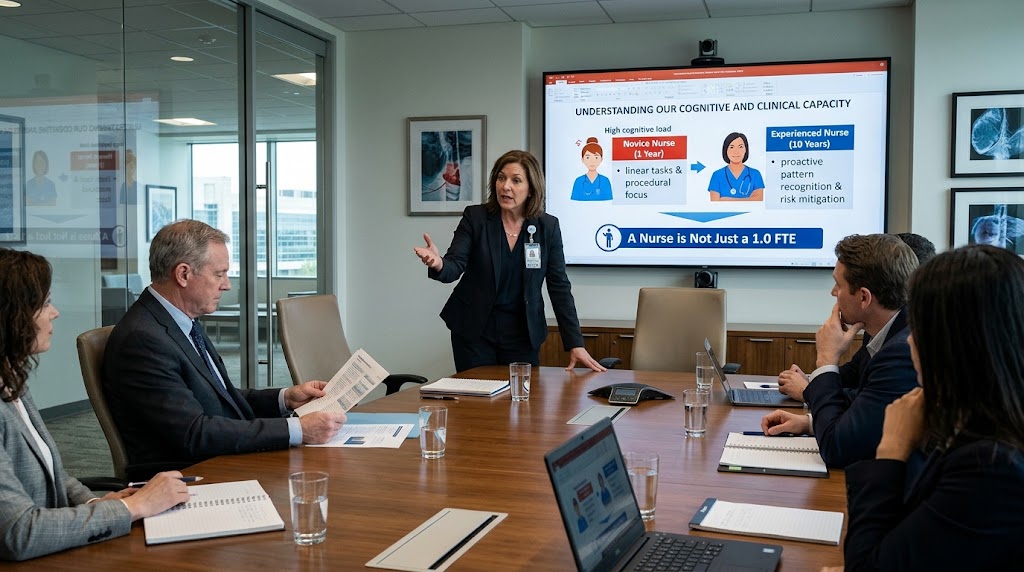
As more nurse leaders struggle with novice density (and its accompanying challenges) on their units, they increasingly face criticism from C-suite colleagues. Consider the story a CNO recently shared with me:
I just met with our CFO this week. He reviewed the productivity dashboard for 4-East, one of our medical-surgical units. He noted the unit was staffed at 98% of its budgeted FTE. On the positive side, staffing was stabilizing, and agency spend on this unit was down 40%. But his balanced scorecard showed a spike in overtime toward the end of shifts, a 0.4-day rose in length of stay, two patient falls, and two rapid response calls that progressed to unplanned ICU transfers. If the unit is fully staffed on paper, he asked, somewhat incredulously, why care isn’t improving. What is driving these challenges? Maybe you should consider putting the nurse manager on a performance improvement plan. In his words, every RN on that unit should be fully competent to work there. After all, he pointed out, we pay them a lot of money to care for patients. How can I better explain the role of experience in patient care outcomes? This unit now has 60% of RN staff with less than two years of experience.
That’s a great question, and so many CNOs are grappling with it. Consider the difference in care that two nurses on that unit might provide:
-
Nurse A (1 year of experience): Diligent, conscientious, and technically competent with routine orders. However, Nurse A operates under high cognitive load. She relies heavily on checklists, standard operating procedures, and linear task execution: vital signs, medication administration, dressing changes, charting. When a patient’s systolic blood pressure drifts from 130 to 105, and urine output slows to 25 mL/hr, she sees two numbers that still hover near acceptable parameters. She documents them dutifully.
-
Nurse B (10 years of experience): Operates with extensive pattern recognition and situational awareness. When Nurse B sees the exact same subtle drift in vitals, she doesn’t see two isolated numbers on a screen; she recognizes an emerging, early-stage septic picture. Within five minutes, she auscultates lungs, reviews the prior 24 hours of intake and output, notifies the hospitalist, and initiates a fluid bolus—preventing a code blue three hours later. Furthermore, while managing her own assignment, Nurse B intuitively tracks unit rhythm, decompresses the charge nurse, and mentors junior peers.
How Non-Clinical Colleagues View Nursing
Explaining that difference to non-clinical colleagues focused strictly on outcomes and budget is not easy. Non-clinical leaders can easily mistake nursing work for a series of scheduled tasks: passing medications, changing dressings, recording vitals, and completing documentation. If those tasks get checked off, people assume the shift is running smoothly. When an executive team views staffing strictly as headcount rather than cumulative clinical capacity and cognitive bandwidth, they miss why a unit staffed with novice clinicians can appear fully covered on a dashboard while operating on the precipice of clinical failure.
A Different Strategic Approach
One strategy is to tell the story differently, using analogies your business colleagues can understand. Non-clinician executives manage risk, capital allocation, and operational capacity. Explaining nursing experience through the lens of “caring” or “stress” rarely changes their perceptions of what is happening. Instead, use an analogy like this: “If our IT department had an opening for four software engineers to build the core infrastructure of our revenue cycle, would you hire four entry-level boot-camp graduates and expect the system to run without system crashes?”Everyone understands that junior coders can write lines of code, but senior architects anticipate failure modes, debug complex errors, and keep the system resilient. A hospital unit functions the exact same way.
She can explain that ideally, the 4E nurse manager would love to have 80% experienced or expert nurses, but that is not who is in our current applicant pool, and given workforce projections, we won’t get there for the foreseeable future. A nurse with ten years’ experience is not simply 10% faster at hanging an IV bag. The level of surveillance they are providing is markedly different. Experienced nurses detect subtle physiological deterioration early, directly curtailing costly unplanned ICU transfers. Seasoned clinicians know how to navigate interdisciplinary roadblocks, advocate for timely consults, and proactively coordinate discharge education days in advance, thereby reducing the LOS. A novice-heavy unit like 4E experiences discharge delays not from a lack of effort, but because discharge coordination requires high-level prioritization that takes years to master. An invisible tax on experienced nurses on novice-dense units increases burnout and exhaustion, compounding turnover.
My Recommendations Moving Forward
I recommended the CNO have the nurse manager on 4E conduct both a novice-density review (see blog on Assessing Novice Nurse Density on Units and Shifts) (opens in new tab) for the unit and a cumulative acute-care experience review for each shift. Once the CNO has the data, she can respond by saying: “Our unit is currently at 100% budgeted FTEs, but our cumulative clinical experience index has dropped by 45% over the last two years. While our shifts are legally covered, our cognitive safety buffer is thin.” She can also tie experience to the hospital’s margin: “The cost of one preventable ICU transfer due to delayed sepsis identification equals roughly $15,000 to $20,000. Retaining and balancing experienced nurses on night shift isn’t an overhead expense; it is our primary loss-prevention strategy.” If she is looking for higher ratios or more support on these units, she could say: “A 1:4 nurse-to-patient ratio assumes a standardized capacity to absorb acute volatility. If a nurse with nine months of experience takes four complex post-ops, that assignment carries a fundamentally different operational risk profile than if an experienced nurse takes it.”
If we want non-clinician executives to see beyond raw FTE counts, nurse leaders must modify how we currently talk about staffing and start educating our executive peers in the language of operational risk, capacity, and asset preservation. Introduce terms like cognitive bandwidth, surveillance capacity, and experience dilution. Treat your seasoned clinicians as irreplaceable operational stabilizers whose loss directly threatens throughput, safety metrics, and financial margins. Recently, I led a session on the Inverted Pyramid of Nursing Experience at a hospital where the CNO asked the CEO and CFO to sit in on the program. During a break, the CEO told me the content was invaluable and applicable beyond nursing.
Your C-suite colleagues are not indifferent to patient care; they simply operate with different mental models and dashboards. We have a responsibility to connect bedside experience to the organization’s strategic priorities. Bridging the divide between the boardroom and the bedside starts with how we frame the problem. When we teach executives that an FTE is not a plug-and-play cog, we protect our patients, decompress our novice nurses, and retain the veteran clinicians who hold our health systems together.
© emergingrnleader.com 2026
To lead through these challenges and others effectively, nurse leaders need new tools and strategies. Let me help; I have helped hundreds of organizations over the past six years. Please contact me at roseosherman@outlook.com to book a workshop or keynote for your team. Not seeing what you want on this list? Feel free to reach out, and I am happy to design a custom program to meet your needs.
Staying Power: Building a Culture of Retention in the New World of Work
Brand New in 2026 with Rave Reviews – The Inverted Pyramid: Leading Teams of Novice Nurses The Inverted Pyramid WS Information Sheet
Our Most Popular Right Now –The New World of Work Workshop
A Leader Favorite – Building Bridges Not Walls: Leading Multigenerational Work Teams – Click Here for More Information Building Bridges Not Walls
A Must-Read Book in 2026 – Click Here to Buy

Standard Work for Novice Nurses: Stop Expecting Them to Figure It Out
2026-10-15 01:00:23By Rose O. Sherman, EdD, RN, NEA-BC, FAAN
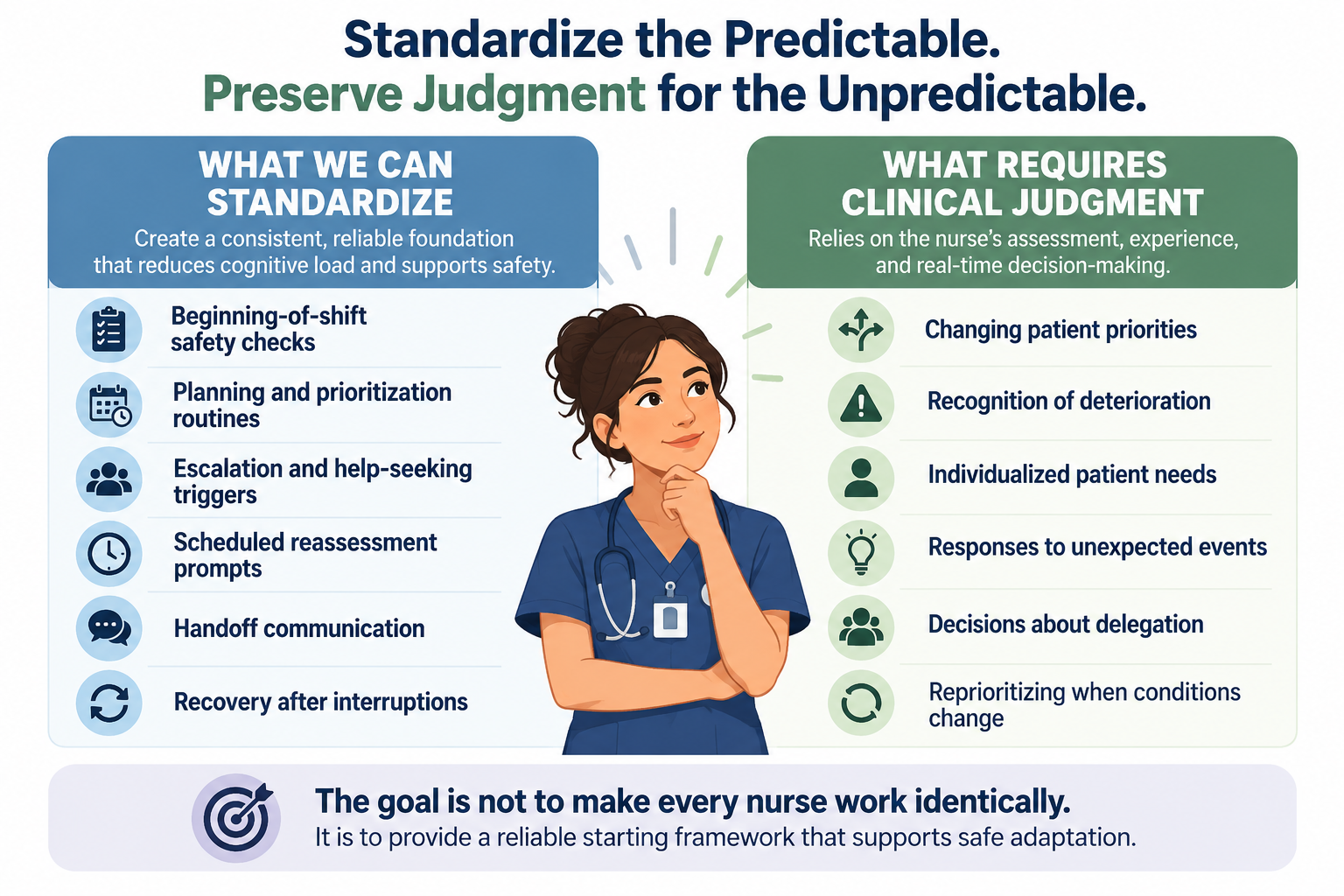
In recent workshops I’ve led on the Inverted Pyramid, many leaders have asked for my thoughts on standardized work for novice nurses. Consider the following story from a nurse manager:
I am not quite sure what to do, but more and more of my coaching conversations now focus on helping my novice staff stay on track during the shift. By 9:00 AM, many are already drowning and behind on their first medication pass. These nurses are smart, but everything still feels overwhelming. Our preceptors are working with them on time management, but they still struggle to pace themselves during the shift. What can I do about this?
This nurse manager is not alone in her frustration. When experienced staff and leaders watch novices struggle to complete routine tasks, they may assume they lack time management skills or motivation. In reality, they are cognitively overloaded. In the traditional nursing workforce, novice nurses learned shift organization by observing experienced colleagues. Much of this learning happened informally. Experienced nurses modeled how to anticipate problems, sequence care, recover from interruptions, and recognize when a plan needed to change. In today’s inverted-pyramid environment, that informal learning system is less reliable. We have fewer experienced nurses available to demonstrate the invisible work of organizing a shift. What was once learned through observation must now be taught more intentionally.
On novice-dense units, we need to provide more scaffolding and standardized work to guide them. Now you may be thinking, but we already have so many policies and procedures that should guide the work. Most clinical environments are flooded with clinical policies. If a novice nurse wants to look up how to flush a central line or administer a blood transfusion, our policy libraries offer pages of dense procedural steps.
What policies fail to provide is shift choreography. It wasn’t as necessary when most acute care workforces were made up of many experienced nurses. Experienced nurses don’t survive 12-hour shifts by consulting policy manuals; they survive on internalized mental models developed over years of pattern recognition. They know intuitively that if they don’t draw a 10:00 AM lab by 08:45, the entire morning falls apart. Novices don’t possess this level of intuition. That is where standardized work comes into play.
What is standardized work?
Standardized work is an agreed-upon, documented baseline of the safest, most efficient, and most reliable sequence of actions currently known to perform a specific process. Standardized work is cognitive scaffolding. It externalizes clinical memory, organizing predictable tasks into a visual rhythm so the nurse’s mental bandwidth remains free for changes in patient condition.
How do you design standardized work?
The definition and framework for standardized work draws from three primary bodies of literature: foundational lean operations, clinical patient safety/cognitive load theory, and healthcare management science. While relevant nursing literature exists on checklists, structured handoffs, care bundles, lean processes, cognitive aids, and nurse leader standard work, there is little guidance on standard work for novice nurses. The following are some ideas to get started:
Step 1 – Create a Standardized First 90-Minute Workflow
The first 90 minutes determine whether a novice controls the shift or the shift controls them. Standardize this launch window by including what should happen, while acknowledging that a nurse may need to administer a time-critical medication or respond to a deteriorating patient before completing a routine safety sweep. Likewise, charting critical assessments cannot always be deferred.
-
The Routine: Start with routine items that should occur, such as bedside shift report, then move to a safety sweep (lines, airway, pump settings), and finally to priority assessments.
-
The Pause: Recommend a five-minute planning pause after receiving report, during which the novice identifies the three highest priorities, time-sensitive tasks, and potential conflicts.
-
The Rule of Deferral: Explicitly tell novices what not to do during this window. Routine charting, non-urgent linen changes, and non-emergent family calls should be systematically deferred until after the initial clinical baseline is locked.
Step 2 – Establish Escalation Triggers
Novice nurses frequently delay asking for help because they fear looking incompetent or annoying a busy charge nurse. Vague advice like “Call me if you get overwhelmed” does not work. Replace subjective hesitation with objective operational triggers:
-
“If your 09:00 med pass is delayed past 09:45, notify the charge nurse.”
-
“If you cannot obtain IV access on the second attempt, stop and call the resource nurse.”
-
“If an admission arrives while you are completing an urgent transfusion, activate the unit buddy system.”
When the trigger is objective and measurable, seeking help is no longer seen as a personal failure—it is simply following standard protocol.
Step 3 – Shift to Process Rounding
When leaders or charge nurses conduct rounds, asking “Are you doing okay?” consistently yields a reflexive “I’m fine,” even when the nurse is overwhelmed.
Instead, ask process-oriented questions that reinforce standard work:
-
“Which task took longer than expected during your morning round?”
-
“What is one thing on your list right now that, if we take it off your plate, will keep your afternoon on schedule?”
Step 4 – Provide Guidance on How to Reset When Things Go Off Track
Novice nurses often start with a reasonable plan. The problem is what happens when an admission arrives, a patient deteriorates, or several unexpected requests interrupt their workflow. Experienced nurses have developed strategies to recover. Novices often have not. Provide guidance on what to do, such as:
-
Pause: Recognize that the current plan needs to change.
-
Reprioritize: Identify immediate safety needs, time-sensitive tasks, and what can safely wait.
-
Redistribute: Ask for help, delegate appropriate work, or activate the unit’s support system.
-
Reset: Establish a revised plan for the next 30–60 minutes.
Nurse leaders should not simply tell novices to follow standardized work. They need to design it with frontline nurses and preceptors, test it, and revise it based on what actually happens during a shift. If multiple novices are consistently behind by 9 AM, the problem may involve medication schedules, admission patterns, assignments, interruptions, or unavailable resources—not just the individual’s ability to organize care.
Standardized work is not about turning nurses into robots or reducing professional nursing to a checklist. It is about recognizing that we have fundamentally changed our workforce experience without always redesigning the systems that support clinical practice. Experienced nurses developed their organizational skills over years of practice, often with strong role models nearby. Today’s novices need us to make that invisible expertise visible. By standardizing predictable work, creating clear escalation triggers, and teaching nurses how to reset when a shift goes off track, we can reduce unnecessary cognitive burden while strengthening clinical judgment. In an inverted-pyramid environment, standardized work is not micromanagement. It is a safety net.
My Challenge to You
This week, ask three novice nurses: “What part of your shift is hardest to organize, and what guidance would make it easier?” Look for patterns in their answers. Then work with your preceptors and experienced nurses to create one simple, standardized workflow that addresses a common challenge. Pilot it, gather feedback, and refine it before expanding.
© emergingrnleader.com 2026
To lead through these challenges and others effectively, nurse leaders need new tools and strategies. Let me help; I have helped hundreds of organizations over the past six years. Please contact me at roseosherman@outlook.com to book a workshop or keynote for your team. Not seeing what you want on this list? Feel free to reach out, and I am happy to design a custom program to meet your needs.
Staying Power: Building a Culture of Retention in the New World of Work
Brand New in 2026 with Rave Reviews – The Inverted Pyramid: Leading Teams of Novice Nurses The Inverted Pyramid WS Information Sheet
Our Most Popular Right Now –The New World of Work Workshop
A Leader Favorite – Building Bridges Not Walls: Leading Multigenerational Work Teams – Click Here for More Information Building Bridges Not Walls
A Must-Read Book in 2026 – Click Here to Buy
Breaking the Cycle of Assignment Conflict
2026-10-13 01:00:40By Rose O. Sherman, EdD, RN, NEA-BC, FAAN

If you walk into many acute care units during shift change today, the tension is palpable. That tension usually comes not from a code or several unexpected admissions, but from the assignment board. In conversations with charge nurses now, they report that their main source of interpersonal friction isn’t conflicts with providers or families, but pushback from their own team over patient assignments. Increasingly, nurses flatly refuse assignments or demand trades before they have even rounded on patients, reviewed baseline vitals, or assessed their patients. As one charge nurse explained:
No one wants to be in charge anymore because it is a no-win situation. I get exhausted arguing over assignments. It is not worth the premium pay. Some of my colleagues are so difficult and only think about their own needs. Even novice nurses today seem conditioned to say no to their assignments, not “let’s talk about this,” but “I can’t do this.”
This knee-jerk reaction to assignments puts charge nurses in an impossible bind: balancing overall unit safety against peer resistance. Resolving this friction requires understanding what drives assignment resistance and replacing subjective debates with objective criteria. The instinct to refuse an assignment before report is finished is rarely rooted in laziness. It is usually driven by cognitive overload, fear, or lack of understanding of how assignments are made. Common reasons staff refuse assignments include the following:
- Novice Vulnerability and Cognitive Overload: Early-career nurses struggle to plan and prioritize care. When they see an assignment that looks heavy on paper, they may immediately go into panic mode before they even see their patients. The panic that you see is often the novice thinking – I don’t even know what I should do in the next 30 minutes.
- The “Black Box” Perception: When assignments are made behind closed doors, or when patient-assignment criteria aren’t perceived as objective, nurses may assume favoritism or unfair distribution.
- Feelings of Loss of Professional Autonomy: In environments where nurses feel little control over their day, refusing an assignment can become the only boundary they feel they can enforce.
When it comes to assignments, subjectivity fuels resentment. Charge nurses shouldn’t have to negotiate assignment fairness on the fly. Units should co-create both general guidelines that guide assignment making Sample Unit Guidelines for Making Assignments as well as specific guidelines such as the following:
- Hard Caps on Clinical Combinations – such as total care patients, patients with active GI bleeding, and ventilator-dependent patients.
- Geographical Clustering – guidelines should emphasize geographical clustering of patients to reduce physical fatigue, improve surveillance, and avoid missed alarms over arbitrary numeric balancing.
- Acuity and Patient Intensity Scoring in Addition to Any Established Ratios
- The Escalation Process for Assignment Disagreement – for example – prior to any change, the charge nurse and nurse will do a real-time bedside scan to assess patient stability before any swap is approved.
- Task Sharing Contingencies: If the assignment cannot be changed, what unit contingencies support task sharing, such as the charge nurse administering initial IV antibiotics for assigned patients and the RN providing PCT support for the shift?
- Check-Back Requirements: If the assignment cannot be changed, what check-back follow-up will the charge nurse do during the shift to assess how the workload is being managed?
Recurring assignment disputes are an excellent topic for unit practice council discussion and staff nurse input. Charge nurses should orchestrate clinical care, not spend precious time every shift negotiating patient assignments. The only way to avoid the conflict is to be more explicit about our processes. Developing clear unit guidelines for patient care assignments is a good starting point.
© emergingrnleader.com 2026
To lead through these challenges and others effectively, nurse leaders need new tools and strategies. Let me help; I have helped hundreds of organizations over the past six years. Please contact me at roseosherman@outlook.com to book a workshop or keynote for your team. Not seeing what you want on this list? Feel free to reach out, and I am happy to design a custom program to meet your needs.
Staying Power: Building a Culture of Retention in the New World of Work
Brand New in 2026 with Rave Reviews – The Inverted Pyramid: Leading Teams of Novice Nurses The Inverted Pyramid WS Information Sheet
Our Most Popular Right Now –The New World of Work Workshop
A Leader Favorite – Building Bridges Not Walls: Leading Multigenerational Work Teams – Click Here for More Information Building Bridges Not Walls
A Must-Read Book in 2026 – Click Here to Buy
“We” for Wins, “I” for Losses: Leadership Accountability
2026-10-08 01:00:54By Rose O. Sherman, EdD, RN, NEA-BC, FAAN

In his book Good to Great, Jim Collins points out that great leaders look out the window when talking about success and look in the mirror when assigning responsibility. In leadership practice, this means committing to saying “We” for wins and “I” for losses. It is one way to build unshakeable trust on your team, as a nurse manager recently pointed out during a workshop.
But in reality, this can be hard for leaders. When things go wrong on units or in departments, human nature pushes many leaders toward self-preservation. We may explain away declining performance metrics, higher-than-average turnover, budget issues, or low customer satisfaction scores. Conversely, when things are going well, many leaders default to making sure they get credit for their successes. This can create a toxic pattern of credit hoarding and blame-shedding.
When a leader uses “I” for triumphs and switches to “they” for failures, staff morale deteriorates. Staff become less engaged because they realize they will bear the downside of failure while surrendering the upside of success.
Why the “We” for Wins is Powerful
Shifting the narrative of success to “We” isn’t false modesty; it’s an accurate recognition of operational reality. Ideas and goals are great, but execution is what creates value, and execution is inherently collaborative. In healthcare, most efforts are team efforts. When leaders share success, two things happen:
- It builds psychological safety: When staff know their contributions are recognized publicly, they become more invested in the unit’s collective outcomes.
- It creates engagement: Teams don’t work hard to validate the leader’s ego; they work hard when the outcomes of their efforts are celebrated.
- It creates a team-first mindset: Building strong teams is challenging today. To believe teamwork matters, you have to see it in action. Nothing demonstrates this more than a winning team.
Why the “I” in Losses Builds Commitment
Your team wants to trust you, and trust begins with accountability. Accepting accountability for losses doesn’t mean you tolerate underperformance. It means that you recognize that what happens in a system and operational clarity starts and ends with you. If your team makes mistakes or misses an important performance metric, you look inward and ask the difficult questions such as:
- Did I establish clear priorities?
- Could I have communicated expectations more clearly?
- Did my team have the knowledge, skills, and resources they needed to accomplish the goal?
- Did I ignore warning signs because the truth was inconvenient?
- Were my expectations realistic for this team?
Putting these Principles into Practice
Self-auditing in leadership is an important skill. So how will you know if you have put these principles into practice:
- Audit the pronouns you use in communication – Review your emails and presentations for the pronouns you are using to talk about results. When did you write “I” when it should have been “We,” and when did you use “We” when you should have stepped up and said “I”?
- Praise in public, correct in private – Never critique an individual or your team in a public forum. Take the heat for the failure and then work in private with the team to dissect where the breakdowns occurred.
- Conduct blameless post-mortems – When reviewing mistakes, focus on processes and communication gaps rather than personal culpability. Always ask: What flaws in our system allowed this mistake to happen?
Leadership is not a platform for personal reputation (although some leaders behave this way). It is an obligation to provide resources, clarity, and sometimes cover for your team. When leaders are willing to personally absorb the shock of failure and redirect the spotlight to successes, amazing things can happen.
© emergingrnleader.com 2026
To lead through these challenges and others effectively, nurse leaders need new tools and strategies. Let me help you as I have helped hundreds of organizations over the past five years. Please contact me at roseosherman@outlook.com to book a workshop or keynote for your team. Not seeing what you want on this list? Feel free to reach out, and I am happy to design a custom program to meet your needs.
Brand New For 2026 and Already Receiving Rave Reviews – Staying Power: Building a Culture of Retention in the New World of Work
Brand New for 2026 and Already Popular – The Inverted Pyramid: Leading Teams of Novice Nurses The Inverted Pyramid WS Information Sheet
Our Most Popular Right Now –The New World of Work Workshop
A Leader Favorite – Building Bridges Not Walls: Leading Multigenerational Work Teams – Click Here for More Information Building Bridges Not Walls
A Must-Read Book in 2026 – Click Here to Buy
Leadership Intensity: The Hidden Costs of a Novice-Dense Workforce
2026-10-05 15:43:19By Rose O. Sherman, EdD, RN, NEA-BC, FAAN
As I lead workshops on the Inverted Pyramid of Nursing Experience™, the content seems to be deeply resonating with a growing number of nurse leaders who now see this phenomenon on their units. One leader recently explained, “You are providing a framework for what I am seeing on my unit, but even more important – you are explaining why I am feeling overwhelmed and exhausted so much of the time. I thought I was just getting old and maybe nursing leadership is just too much for me now, but I now see from what you are saying – how much my role has changed as the number of inexperienced nurses on my unit continues to grow.”
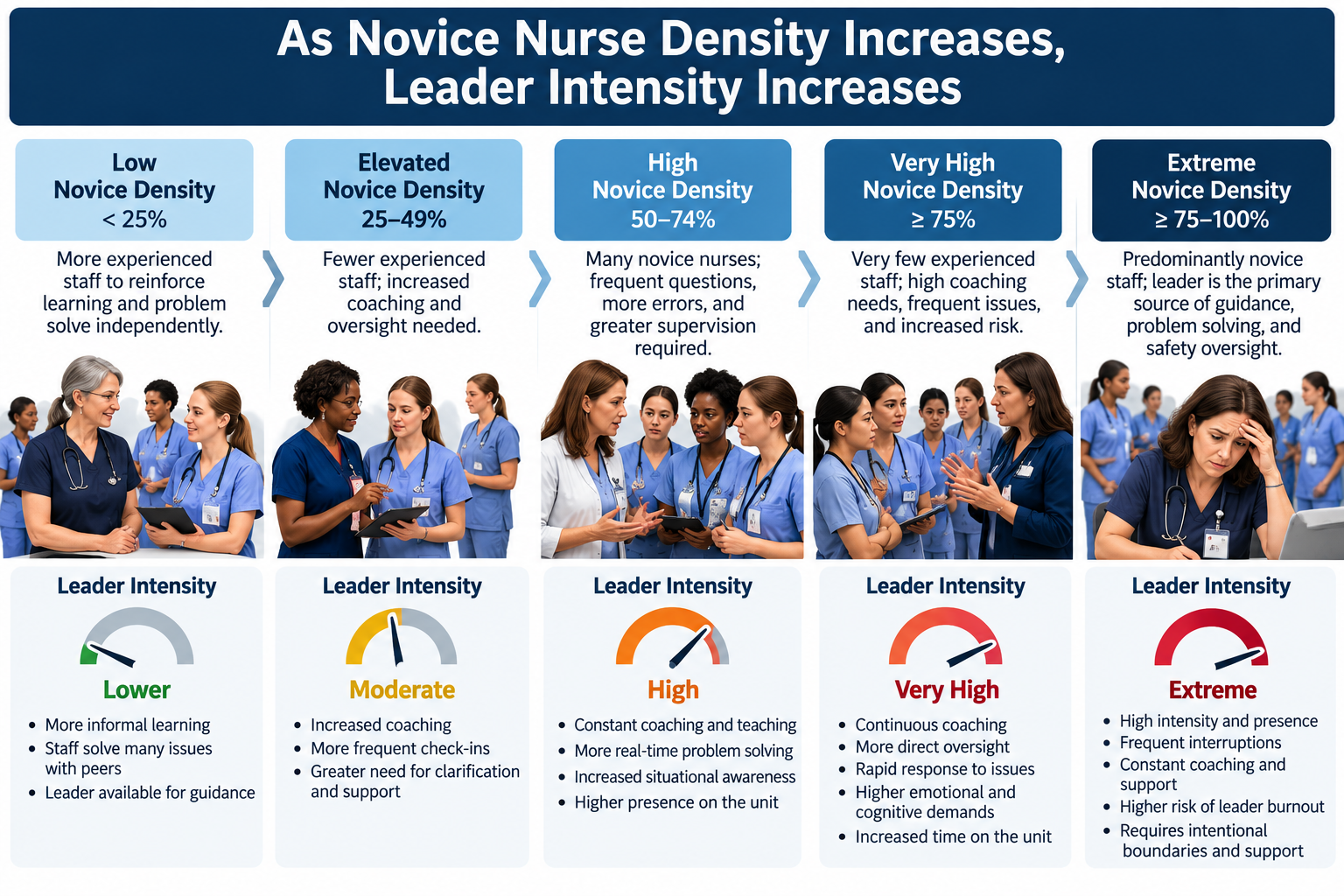
When a team shifts from a majority of experienced staff to a growing percentage of early-career staff, the supervisory burden multiplies. This dynamic is called Leadership Intensity, or the compounding strain that drains unit leadership when novice density reaches critical mass. The escalation curve can look like the following on a unit:
-
Low Density (< 25%): Teams maintain a healthy ratio of experienced mentors. Peer-to-peer problem-solving flourishes, and informal learning handles day-to-day uncertainties without pulling leaders away from strategic work.
-
Elevated Density (25–49%): The loss of senior peers creates small support gaps. Leaders step in for targeted check-ins, structured coaching, and frequent workflow clarifications.
-
High Density (50–74%): As novices outnumber veteran peers, questions compound and routine error rates tick upward. Managers shift from macro oversight to continuous, real-time troubleshooting and persistent situational awareness.
-
Very High to Extreme Density (75–100%): Informal peer coaching collapses. The unit leader becomes a key backstop for safety oversight, technical problem-solving, and guidance.
Many units today are in the high-, very high-, to extreme-density range. This dramatically shifts nursing leadership workloads, even when all other aspects of the span of accountability stay the same.
The Hidden Costs of Increasing Leadership Intensity
When organizations ignore novice density, the real costs manifest across three primary operational layers:
-
Cognitive Fragmentation & Interruption Fatigue: At extreme density, managers navigate relentless context switching. Urgent tactical firefighting crowds out strategic planning, talent development, and process improvements.
-
Leader Burnout & Attrition: Extreme intensity demands sustained vigilance and deep emotional resilience. When frontline leaders are consumed by safety backstopping, their risk of rapid burnout escalates sharply.
-
Depleted System Resilience: Without an intermediate layer of seasoned talent, institutional memory vanishes, leaving the team vulnerable to sudden surges or unexpected crises.
Rebalancing the Equation
Units with high novice density need more structural support than simply adjusting span of accountability. To decide what structural support is needed and for what units, organizations should do the following:
-
Track Experience Ratios, Not Just Headcounts: Measure unit-level novice density and average acute care clinical experience alongside standard vacancy metrics.
-
Build Mid-Tier Buffers: Staff novice-dense units with assistant managers, resource nurses, charge nurses without assignments, and unit-based educators so frontline nurse managers do not absorb 100% of novice coaching needs.
-
Protect Leader Capacity: Advocate for strict leader boundaries, hard stops to leader days, and support groups to help nurse leaders deal with the leadership intensity on their units.
A fully staffed shift means very little if the collective experience on the floor cannot sustain itself. When we treat headcounts as interchangeable numbers, we pass the hidden tax of a novice-dense workforce directly to our frontline leaders—until their capacity, resilience, and willingness to absorb the pressure finally run out.
True workforce stability isn’t just about filling vacancies; it requires protecting the balance of skill and intentionally safeguarding the bandwidth of those we ask to lead. If we want safe environments, high-performing teams, and sustainable leadership, we must stop asking managers to be the shock absorbers for an unbalanced system and start designing staffing models that account for the true cost of having an inexperienced staff.
© emergingrnleader.com 2026
To effectively lead through these challenges and others, nurse leaders need new tools and strategies. Let me help you as I have helped hundreds of organizations over the past five years. Please contact me at roseosherman@outlook.com to book a workshop or keynote for your team. Not seeing what you want on this list? Feel free to reach out, and I am happy to design a custom program to meet your needs.
Brand New For 2026 and Already Receiving Rave Reviews – Staying Power: Building a Culture of Retention in the New World of Work
Brand New for 2026 and Already Popular – The Inverted Pyramid: Leading Teams of Novice Nurses The Inverted Pyramid WS Information Sheet
Our Most Popular Right Now –The New World of Work Workshop
A Leader Favorite – Building Bridges Not Walls: Leading Multigenerational Work Teams – Click Here for More Information Building Bridges Not Walls
A Must-Read Book in 2026 – Click Here to Buy
[news count=”4″ pagination=”2″ terms=”24,22″][/news]


 LinkedIn
 Instagram